

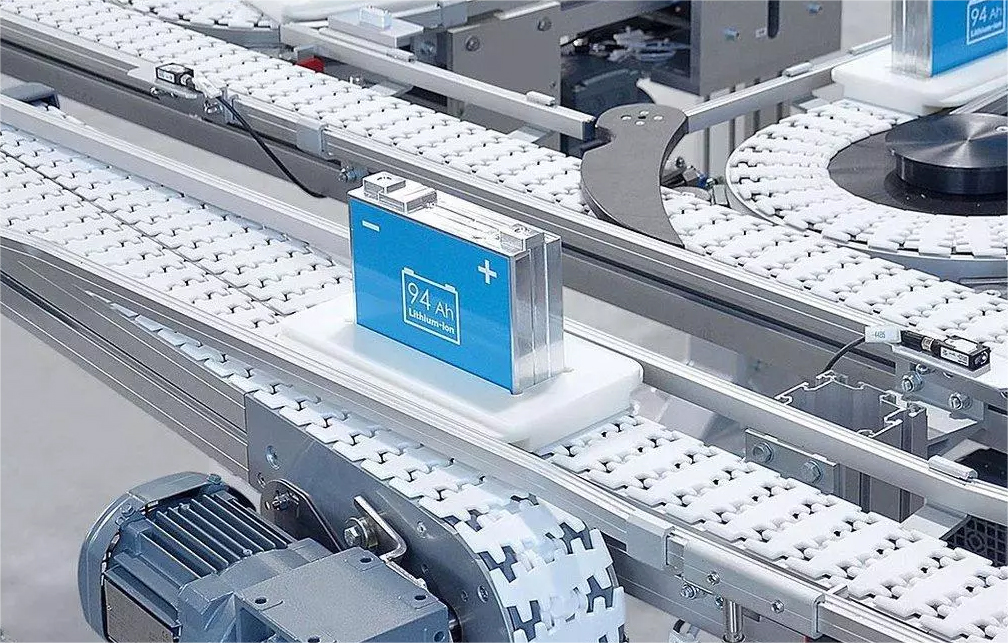
ENGINEERED AROUND THE BATTERY PROCESS
Cell, module, and pack production require different handling strategies.
In Argonne National Laboratory’s BatPaC manufacturing model, cell stacking, welding, X-ray inspection, electrolyte filling, and sealing are performed in a dry room with a maximum reference dew point of −40°C. Conveyors entering this area must therefore be evaluated for particle generation, material compatibility, lubrication, maintenance access, and transfer through environmental boundaries.
Formation creates a different problem. The same model includes 1–2 days of initial ageing followed by formation cycling and ageing over 1–2 weeks. It uses conveyors, stacker cranes, grading equipment, and an information system to manage cell movement and quality data. This means buffer capacity should be calculated from residence time, carrier quantity, test availability, and reject-routing logic—not from conveyor speed alone.
CONVEYOR SOLUTIONS FOR BATTERY PRODUCTION
CSTRANS develops material-flow sections for:
- cell carriers and precision pallet transport
- stacking, welding, inspection, filling, and sealing machine connections
- formation, ageing, testing, and grading logistics
- automatic identification and process traceability
- good-product, rework, and reject routing
- module assembly and controlled positioning
- pack assembly, testing, and heavy-load transfer
- accumulation, lifting, turning, and line balancing
Flexible chain conveyors are suitable for compact routing and lighter components, while pallet conveyors provide repeatable positioning for automated processes. Larger modules and battery packs may require roller, belt, lift-transfer, or dedicated heavy-duty carrier systems.
Each line should be configured from the battery format, carrier load, positioning tolerance, environmental zone, process cycle times, traceability architecture, and machine interfaces—not selected as one general-purpose “lithium battery conveyor.”


